Section 1: Geography’s futures in context of the past
What is the future of Geography in a world increasingly focused on economic productivity, innovation, intensified resource use, AI, media and technology? Or should we be asking proactively as geographers, from whatever perspective/s we use, or situation we are in, what sort of environment and society do we wish for or are prepared to work for? And of course, under the three-party Coalition, how might we handle a political culture that ignores consultation and transparency, issues policy by decree without evidence or plan, rolls back Te Tiriti gains, and denies access to elected politicians. The first question acknowledges new realities. The second keeps open the idea that geographers can and must engage actively in whatever decision-making processes appear in the new order. The third bluntly confronts the terms of non-engagement that are prevailing. These are questions the authors began asking themselves late in 2024 after Ministerial announcements defunded the Marsden Social Sciences and Humanities panels which had supported much geographical research in the universities, research organisations and consultancies. The move saw Aotearoa New Zealand (hereafter Aotearoa) join what other parts of the world were already experiencing, that is, a refocusing of government funding away from the social sciences and humanities towards STEM subjects, the physical sciences and technology (Gordon & Argue, 2024). Why? Because these disciplines are perceived by the new Coalition government as more likely to deliver outputs to benefit economy. The severity of the funding impacts in Aotearoa should not be underestimated. We concluded Aotearoa Geography is facing an existential crisis to which an urgent response is required.
What is at stake? Aotearoa Geography’s nexus of education, institutions, and international links
The idea of a nexus of co-constitutive axes of education, institutions and international links reveal the unique makeup of Aotearoa’s Geography. Nexus suggests multiple intersecting and ongoing trajectories of geographic endeavour. In brief, education remains Geography’s primary home. The links to schools via the New Zealand Geographical Society (NZGS) are notable. Institutions stress who is doing what where. The universities are important hubs hosting branches and at the centre of international links. But they are matched by often overlooked vigorous NZGS and New Zealand Board Of Geography (NZBOGT) roles (see Hay, 2025, for a similar argument about community-based societies in Australian geography). International links reflect energising impulses from abroad or taken abroad. The axes embrace developments throughout Geography’s post-WWII existence, as a discipline nationally and internationally, a school subject and in the communities, cities and regions.
What were some key developments: The first Geography lecturer was appointed at Canterbury University in 1936 (Roche, 2010), Geography departments were created as the country’s university system expanded. The NZGS, with branches, was established through academic and community support. Two journals were founded, one for research and another for teachers. Popular interest in Geography saw well attended branch meetings where different geographical findings and debates were presented, Proceedings were published after conferences. Geography grew as a high school subject (Whatman, 1969) and was supported by a Geography Resource Centre. Graduates obtained jobs in government departments (some rising to Heads of units) in addition to teaching, while early graduates seeking doctorates left the shores, The Royal Society of New Zealand recognised the discipline, so strengthening international engagement, university departments created visiting lecturer schemes, while Aotearoa geographers engaged in International Geographical Union (IGU) Research Commissions. In recent years, responding to falling student numbers in schools and universities, NZGS and the NZBOGT began creating on-line resources prepared by practicing geographers. In 2025 a media-driven ChooseGeography campaign aimed at schools and university undergraduates was initiated.
Geography is a knowledge infrastructure (Edwards, 2016), involving a collectively oriented network of people, artifacts and institutions that generates, shares and maintains specific knowledge about the human and natural world. Arguably contemporary Aotearoa’s Geography is a repository of original knowledge initiatives from a breadth of geographers exercising capacities and capabilities and a generator of frontier research agenda, all resting on critical localism, diverse framings, exploration of Māori knowledge, and ultimately planetary mindfulness. Aotearoa continues to benefit from its foundational knowledge infrastructure.
Outlining where we individually and collectively might go
We are four practicing geographers of different generations and persuasions (social, environmental, cultural, economic and political geography with research associations with Māori geographers and Māori colleagues) who are confronting the future(s) of Geography in Aotearoa and its wider implications from within a new national and disciplinary reality. The gravity of Aotearoa’s situation, our positionings from close working relations and inter-linked approaches over how to face new and radically different kinds of problems gave us confidence to be bold by focusing on ways of approaching personal and collective action as a response to Geography’s new situation. Through discussion we noted how we had each used practical and grounded steps to address daunting research circumstances in the past. Wider conversations suggested others in the geography community were also seeking to re-position themselves. Our interwoven research journeys aided us in figuring out how we might do the practice of co-evolving Geography with others. The practical steps were always about readying ourselves to gain levels of awareness that meant the practices and assumptions of the comfort zone of the past had to be seen as inadequate. Put another way, we were trying to resource ourselves, individually and in groups. We concluded this was being resourceful or skilled at finding new and novel ways to solve problems, make hard decisions and achieve varied goals, especially in difficult circumstances.
We treat the situation as a ‘forced opportunity’ to put aside protest and critique about what has happened and examine instead the realities and dilemmas facing practicing geographers. We are guided by the premise that futures of whatever sort, are made, by people doing things, embedded in the socio-ecological relations of communities, iwi and hapū, institutions, businesses, places and regions, near and far. Geography’s futures must be made (now and right here where you are).
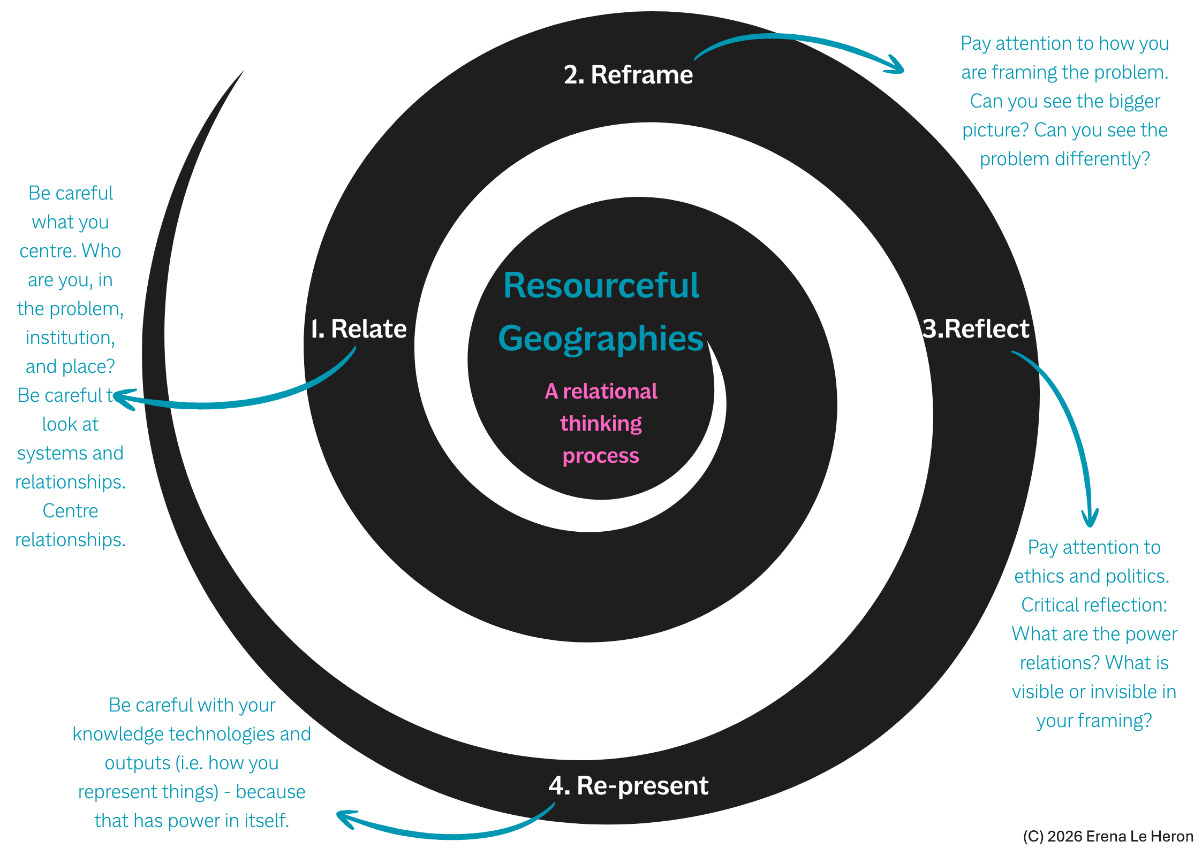
Figure 1, informed by (Greenaway et al., 2023; Le Heron et al., 2020), broadly portrays the paper’s argument of enlivening enactive processes in a multi-faceted Geography with many subdisciplines through use of a package of resources made up of Figure 1 and Tables 1-4. Together the package is intended to cultivate resourcefully informed geographers. To start with we recognise that we are operating in an Aotearoa that is determinedly productive, but it is also an Aotearoa intent on being more productive and veering towards re-intrenchment of colonial and capitalist attitudes. We regard capacities and capabilities as essential to giving prominence to a resourceful disposition about Aotearoa Geography. Being resourceful is not pre-given. Moreover, it is a continuing process of co-learning and translating.

This strategic move is to our knowledge not evident in other disciplines. Our twist is contending that considerable in-situation advantages come from mobilising individual capacities and collective capabilities to aid Geography’s adeptness at seeing interconnections in Aotearoa rather than just separate parts. Finally, we stress that those involved will be pushing their boundaries of thought and action. This approach to helping make geography futures differs greatly from any general ‘declaration’ of what Geography should be, as it centres any geographer in their everyday roles and connections. Our hope is that any practicing or aspiring geographer will see how they can more consciously resource themselves for conditions ahead.
Figure 1 shows a stepped thinking process central to achieving a commitment to being resourceful. It assumes a willingness to delve deeply to build up learnings that will enable ‘doing a re-setting of personal geographical engagement’. It is directed towards gradually introducing discussion about different kinds of situated efforts. The strategy is procedural and evaluative, to help gather understandings about context, circumstance and resolve. While Figure 1 formalises the thinking process, it is intended more as a field of questions which if posed in different settings will aid robust discussion and personal development. The questions we raise at each step may seem strange. They suggest being cautious, honest and yet searching in encouraging explicit learning at each step. Unsurprisingly Relate is personally coming to terms with Geography’s new situation, one’s own situation, regrouping with colleagues and allies over concerns and hopeful directions. After this step we shift interest to how to put to work new-found awareness. Reframing is what might and can be done, with whom and under what terms. It is about what is manageable in institutional settings and their politics. We emphasise manageable because it signals hesitancy over pondering workable connections and indeterminacy inherent in conflicting choices and murky outcomes and associations. Reflect acknowledges tentative development of understanding which will almost inevitably be is subject to repeated critique from different perspectives and positioning of others. Re-present captures the momentum of outlining suggestive transitions involved in moving beyond a business-as-usual position.
Changing political economy contexts
Table 1 depicts Geography’s emergence as embedded in altering political-economic contexts. It’s phasing draws on Blackett et al., 2024; Hikuroa et al., 2025 and Lewis et al., 2024. The table is a reflection on advances and setbacks experienced by Geography over the years and enables a realistic assessment of patterns of disciplinary emergence. With phases as background, distinctive features of Geography’s experiences can be compiled and examined in terms of their contemporary significance. The primary purpose at this stage is gaining some measure of how geographers at large have managed in the past to ground opportunities for the future.
Contextual moments and initiatives: geographers managing over time
When we looked back at ‘responses in context’ we were very (and proudly) surprised. We discerned a remarkable level and variety of knowledge experimentation about how to represent, analyse and critique environmental, economic and regional processes on multiple levels. Equally surprising was that in the milieu of each phase, geographers have always ‘thought aspects of economy while thinking environment’ as they brought their implicit holistic societal lens to bear on adverse land-centred (and more recently coast and ocean) environmental impacts from economic behaviours.
Experimentation in research deviates from conventional approaches. In this respect Geography as a discipline is change oriented. Experimentation follows no previous form, establishing significance from contrast with what has gone before or has not been attempted. Table 2 introduces illustrative examples (chosen by the authors) to highlight the inclination to experiment into new forms of knowledge creation under different conditions. In fairness Geography hasn’t been so pointedly threatened as it is now so the ‘experiments’ haven’t always had personal urgency for those participating. Yet, arguably, such bold and often innovative initiatives are what has distinguished Geography from many other disciplines over the years.
Different generations of geographers have responded to prevailing disciplinary wisdom and societal currents in turn. A great many in the geography community stepped up to guide these ‘at the edge’ ventures in knowledge production. These experimental initiatives are cumulative in their effects, though they represent ‘independent’ knowledge experiments. Over the decades they have led to change in real-world practice and processes, publications, conference presentations and themes, seminars and guest lectures in the tertiary institutions, input into lecture content, books that reached the public eye, and more recently have linked into Māori and other institutions.
Table 2 shows a shift from individual efforts to shades of collective and collaborative effort over Geography’s Aotearoa lifetime. Early books published by the Society were mostly ‘by selective invitation and motivation’. The restructuring phase saw a move away from this model. The Changing Places books in the 1990s took the form of ‘open invitation’. This was a culture shift in Geography practice. The first Changing Places book had 48 contributors, with 70 for the second. The edited volumes were monumental coordination exercises and were, as noted at the time, ‘theoretically informed’. Latterly threads of experimentation have multiplied, involving new styles of teamwork and novel thinking (Dowell et al., 2022).
Fostering capacity and capability to meet societal and environmental issues
Government intervention supported the long boom of expanding Geography, other social sciences and science. By the 2000s, however, government questioned the inability of the proliferating social sciences to speak as ‘one voice’, through a collective interest organisation, as found in the Sciences. The Minister of Education (Maharey, 2004) established BRCSS (Building Research Capabilities in the Social Sciences (2004-2009). It was a trigger moment for practicing geographers, directing attention to future-making work by focusing on getting individuals and collaborations to orient themselves away from purely disciplinary debates and pursuits. BRCSS sought to assemble a wide range of researchers (mid-career researchers, doctoral students, Māori and Polynesian researchers) into a social learning process that was multi- and inter-disciplinary. The intervention sought to create ‘useful’ society knowledge by giving New Zealand’s social science community a chance to ‘mature itself’ through capability building.
Le Heron E. et al. (2011) argue the BRCSS experiment involved researchers with strong opinions about their disciplinary contributions who were asked to ‘suspend their assumptions’ and seek to generate new interdisciplinary knowledge possibilities. Informed by post-structural, especially Foucauldian ideas, they recognised that engagement in substantive issues (in this case Sustainability) was needed to confront how knowledge production might be done differently. Their review identified the centrality and hard work of building interpersonal capacities/capabilities to open new substantive concerns in generative ways.
Reconceptualising knowledge through a methodology of disruptive questioning
So began what might be called the capacity/capability era in Aotearoa social science knowledge production. Economic geographers and sociologists, for example, were leaders in writing a transgressive position piece for the New Zealand Journal of Agricultural Science, advertising an alternative direction for knowledge generation, from ‘Agricultural Science to Biological Economies’ (Campbell et al., 2009). It suggested they could ‘outthink’ so to speak conventional agricultural wisdom. Later Marsden funding led first to an academic book on experimentation as a politics of knowledge and then a public-facing volume sub-titled How New Zealanders are creating value from the land. Radio NZ gave airtime to the second book. Geographers were being taken seriously.
Another Ministerial vision (Joyce, 2013), the mission-oriented ten-year National Science Challenge (NSC) platform dedicated to working on Aotearoa society and environment not disciplinary issues, attracted a very sizeable presence of geographers. The Challenge process coincided with attitudinal changes in institutions, increasing prominence of Kaupapa Māori helped by Treaty Settlement allocations, wide commitment to grounding any research, and a sanctioning of diverse research groups.
In our experience the Sustainable Seas NSC gave latitude to develop the art of reframing how the world could be seen and understood to function differently, through provocative questions. Four contentious projects shown in Table 3 involving the author’s research, provide worked examples of the power of reframing through questioning methodology. The insight is that by posing unexpected and contrary questions, new and situated methodologies and understandings are brought into existence. We see methodology as an underestimated knowledge intervention. It identifies imaginings of how the worlds might be different or altered. In a sense methodology is potentially a release mechanism, from past assumptions, and a portal to answering questions of the sort we posed at the beginning of the paper.
Integration for Impact: Final Challenge phase (2023-2024) bridging to enterprise, policy, community and iwi
The Challenge process became unique when it started to explore how to collaborate with end-users across the board to refashion knowledge from research projects into forms of knowledge understandable and useable in a variety of investment decision-making settings. Integration for Impact was a mega ‘social’ experiment not tried before in Aotearoa. Geographers provided much leadership and direction that integrated Te Ao Māori, social science knowledge, mainstream ecology and economic insights into ‘tools’ for evidence-based decision-making. This was exciting and rewarding activity. The NSC platform ended, five months before neoliberal policy announcements.
In the SSNSC, achievements included co-development of knowledge by equal partners involving Māori communities, businesses and policy makers; research by Māori geographers that overturned Pākehā and science narratives of flooding and risk management (Parsons & Fisher, 2022), experimental co-governance arrangements explored Te Ao Māori and Mātauranga Māori protocol; policy makers and researchers used new face-to-face and webinar techniques to identify necessary capacity and capability attributes in group leadership, co-leadership options, implications of different team mixes and desirable qualities for different circumstances of team member abilities; novel economic and environment possibilities/options/value propositions were codified through intensive probing with investors, and industry and business representatives; and evidence from multiple sources and divergent viewpoints began to be more widely accepted in decision making choices. Significantly, Māori researchers (Johnson et al., 2024), were able to define knowledge problems in their own terms, for their hapū and iwi, and involve Māori researchers. A strong collective ethos for governing natural resources and approaching social questions was emerging. In the Coalition phase this ethos has been imperilled.
Capacities and capabilities immediately available to Aotearoa Geographers c. 2025
Table 4 profiles the capacities and capabilities of Geography. Many entries are familiar and have been part of any university geographic training, professional settings and in some schools. They should demonstrate to any sceptic that practising geographers are adept on many fronts. The examples shown in Table 4 are by no means an exhaustive compilation, and go beyond the ‘describe and explain’ business-as-usual norms relating to knowledge production. They have been used to confront accepted political positions of key actors and resolute pursuit of socio-ecological-economic knowledge in research configurations involving Māori researchers and investors.
Planetary, national, and localised issues that geographers are turning to have recently required capacity/capability stretch. Many geographers in Aotearoa have these competencies at their fingertip and are using them. The table’s importance comes from putting them together to show a heritage. In doing so, it exposes the urgency to personally update the very ideas of capacities (what you can do on their own account as well as abilities to relate to others) and capabilities (the possibilities and opportunities that come from expressly examining strategies and political tactics to arrive at enduring collective contributions).
Table 4 invites two bold claims. Geographers have earned a right to speak critically about the resurfacing dominance of economic growth and its resource extractive imperative and be resolute in proposing re-centrings of how issues are perceived or framed, arguing for methodologically grounded approaches. There is evidence that geographers are at many knowledge frontiers, ready, able and are developing and engaging in future-oriented ‘fit for place, Te Tiriti supportive. ethically centred, equitable, culture, communities and planet’ framings.
Section 2: Making Geography’s futures
This section has two interdependent parts. We start by re-examining current knowledge-making practices and then explore how, in our view, these practices will be generative of new sorts of research and career opportunities.
(a) Knowledge practices
Aotearoa Geography has a tradition of trying to add quality dimensions to understandings of socio-cultural-ecological conditions. We see this tradition as making it easier for us to personally approach our individual and collaborative efforts to help reposition ourselves and re-set directions in Geography.
Being resourceful means thinking laterally in the context we have, that is also fit for purpose and place, and is ideally adapted to our contextual realities – all generated in a short, sharp time frame that allow for quick positives results. We feel this will propel Geography in its sketching of ways to synthesise interests of various strands of society into workable productive wholes on issues, in places, regions and nationally. This is about formalising alternative narratives that side-line the predominantly profit-centric for-capital owners’ framings and their narratives, give credence to ‘loss and damage’ experienced by Māori and help re-imagine nature’s roles in a hopefully productive economy.
But Geography is in a tricky place as it faces the challenges of its flagging fortune, erosion of its customary knowledge-scape, and tries to negotiate new contacts. Combined they might feel unchallengeable, but we emphatically disagree. A focus on building the country’s future opens the door to Geography’s range of future-facing capacities and capabilities. This is about finding or helping create safe and liberating spaces to energise resourceful strategies and tactics. Geographers at large can bring forward a wide range of projects and experiences to validate their claims. We believe this is both where and how geographers, along with social science and allied colleagues can move into ‘modes’ of making futures for the subject, themselves, and Aotearoa.
In this regard practicing geographers are likely to try to make known how environmental stewardship and kaitiakitanga emphasising interconnections in economy, environment and societal systems makes for long-term resilience and well-being. Increasing constraints of mis- and dis-information make this frustrating. They can offer much to the big challenges ahead for Aotearoa and the world more broadly; transitions towards a bioeconomy, zero carbon and energy security, adaptation to climate change, social change and biodiversity, digital innovation, and community wellbeing and prosperity (see Horizon Scans, 2024).
Who’s in Geography’s tent? Who are Geography’s practitioners?
The paper is both an initiative and invitation to share capacity and capability experiences, as they develop, with receptive others. The rationale is that everyone, willing or otherwise is going to be caught up in a general uprising of new kinds of effort – dimensions of which were identified as originating from all quarters of Geography’s infrastructure. Who might be involved? Secondary school geography teachers, those taking geography and social studies, interested parents, university academics, post graduate students forging new frontiers of knowledge, local and regional government central government Ministries, Public Science Organisations, environmental and economic consultancies, Iwi and Pacific Island research organisations in universities, ‘geographers in the wild’ and anyone doing non-traditional Geography but still being very much a geographer. Given the new conditions Geography is in, there is a case for developing a local personalised contact matrix. A similar structure of contacts might be created amongst Geography’s formal entities to advertise available capacity and capability tools.
Cultivating geographical alliances while strengthening cross- and post-disciplinary alliances
There are encouraging signs that NZGS, NZBOGT, researchers, teachers and academics are mounting initiatives involving cross-geography activity. The four yearly joint NZGS-IAG conferences are continuing. NZGS has sought to avoid conference clashes with related constituencies such as DevNet and other social science meetings. NZGS is circulating to its membership international online conferences (e.g. Community Economies Research Network conference on ‘Sensable Agri-food Economies’). The NZBOGT is seeking input from the university Geography departments and units on what competencies they would like students from school geography to have. Satellite meetings in Aotearoa in 2028 are being planned as part of the IGU Congress gathering in Melbourne. A recent overture from the incoming Institute of Australian Geographers President (Cook, 2025) focuses on extending connections into Aotearoa’s Geography community.
Geographers are natural inter-disciplinary, trans- and post-disciplinary collaborators, which has only been strengthened by the last decade of inclusion in the nine National Science Challenges. Strong relationships and understandings with physical science colleagues, economists, lawyers, Māori and Pacific researchers and scholars and their initiatives, and policy and planning practitioners provide expanded opportunities beyond the traditional sphere of Geography’s influence.
Political action and advocacy as citizens and researchers
In asking what sort of environment and society we wanted to live in and pass on, we need to recognise a consequential question. How do we mediate investors, policy makers, politicians, AI interventions, conventional and online media, and investment proposals, so outcomes land somewhere near our hopes? Aotearoa’s government has swung into a neoliberal policy mindset to deliver economic growth outcomes. This is an opportunity for practicing geographers to lay out reason-based arguments on a range of political claims about economic strategy and de-regulation moves and new regulations and practices (Banks, 2025; Scheyvens et al., 2025). This is engagement with the inner workings of democratic processes. Further examples of practical steps geographers can take include: submissions relating to proposed legislation, finding out about the range of consenting processes and how they might be influenced (Lewis, 2024), how to lodge an Official Information Request, letters to the Editor of newspapers, getting assistance in writing an opinion piece to Newsroom or The Conversation, supporting the revived NZ Geographic, writing to local MPs of any persuasion, writing to key ministers in government, signing up to online presentations (e.g. Environmental Defence Society, Fabian Society), providing short reports to government departments and company Directors/management, and making oral submissions to Long Term Plans in local government.
(b) Visioning, knowledge potentialities, possibilities and challenges
Mapping generational and intergenerational perspectives
The paper holds that if one wants to change the world, then one must act in it. But who will do what sort of acting, with whom and to what ends? We ask this population and demographic-centred empirical question because any attempt to answer it requires a focus on generational categories that increasingly define short and long run personal and collective investment choices. On one level there is a dearth of information on the eurocentric categories of Baby Boomers, Generation X, Millennials, Generation Z, and Generation Alpha. What do those so categorised think on most issues? What views have they on medium-term and intergenerational outcomes? Are their views fluid? What of household dynamics? Are there differences in the Māori population, Pacific Island communities, in ethnic groups such as Chinese, Filipino and Indian, and in past and present migrant groups?
While the above generational categories are widely recognised and much talked about, there is an absence of how in combination, in cities and rural areas, by country, the ‘aging and evolving’ generations might approach new challenges. No systematic research has addressed generational and intergenerational issues that will come with contentious topics in the decades ahead, topics such as emerging generational alignments with superannuation eligibility options, composition of inward and outward migration, Kiwisaver contributions, well-being precarity, palliative care, affordable housing, selling off ‘Aotearoa’ assets to overseas interests, commitment in Aotearoa to climate change initiatives, rapid replanting of exotic trees versus intergenerationally motivated replanting of native forests, relocation from flood prone areas, urban density principles, ethical and care-full supply chains. Geographers are well placed to be leaders in assembling independent, evidence-based knowledge on these matters. This is a novel way to draw attention to Geography’s intellectual refashioning.
Knowing the projects, companies, institutions, and legislation in the new regime
For the most part societal commentators have focused on government pronouncements, behaviour and regulatory roll-back in response to the immediacy of neoliberal policies. Geographers of all persuasions are very aware that this is only part of bigger realities. Equally important are the creative mobilities, ensuing volatilities, and active de- and re-coupling characterising all enterprise, whether headquartered in Aotearoa or overseas. Companion to this is a growing presence of ‘organised obstruction’ to discredit climate change science (Climate Social Science Network, 2025). Its salutary conclusion is that opposition is different everywhere, in different industries and cultural institutions. What an empirical challenge for geographers! Table 1 alerts us to the regulatory push in all spheres of life in the 21st century that arguably turned attention away from seeing new forms of colonial-capitalist expansion and dynamics. But geographers have been active in documenting and revealing the wider picture, which is why Table 4 stresses Geography’s penchant to emphasise holistic framings and structural interconnections.
What gives momentum and fluidity to globalising economic processes which are enveloping Aotearoa? We touch on several lines of effort that might give scope for geographers to push their holistic and analytic ingenuity.
First, Aotearoa trained Swedish geographer Brett Christophers (2018) argues that ‘following the profit trail’ is fundamental. He contends there is a systematic world-wide pattern of privatising public assets such as conservation estates, education and health, transportation, infrastructure and so on which opens new resource extraction and extends privately-owned management possibilities. Geographers and Māori colleagues (Lewis et al., 2023; Scobie & Reid, 2024) spell out the influence of international consultants, asset managers and other intermediaries in establishing new lines of Crown, government, enterprise and iwi relations. The issue is what value or returns remain in Aotearoa and who benefits or lose out. Second, big picture overviews are needed, about oligopolies, duopolies and monopolies – banks, supermarkets, energy, and oil companies, and their environmental claims, efforts and actual practices. Lessons from company expansion offshore, some successful, such as Mainfreight, others having to retrench, like Kathmandu and Michael Hill Jewellers. Within Aotearoa there will always be claims and counterclaims over the merits, demerits, and risks of privately owned entities versus what government entities including Public Private Partnerships do, cannot do, and do not do. Geographers are adept at providing comparative evidence on such developments. Third, the flourishing Māori economy is often overlooked. A Ministry for Business, Industry and Employment (2023) report highlights that the Māori economy is a powerful pillar of New Zealand economic future, noting the values-driven approach of whakapapa, kaitiakitanga and intergenerational futures, which shows the true value of taonga such as land and, cannot be reflected on a balance sheet or through numerical examples. In the urban context, Ngarimu Blair, geographer, and Deputy Chair of Ngati Whatua Orakei, stresses that City Rail Link has supported Māori and Pasifika businesses, but ‘true equity’ remains elusive (Afemata, 2025). Fourth, as well as giant investment companies looking to capture monetarized value from Aotearoa assets, there are Māori, Pasifika and ethnic initiatives more concerned with retaining societal and environmental value in place. Fifth, an entirely different approach would be to engage in probing the price and cost of key growth policies like the Roads of National Significance, on a range of spatial and temporal measures. Rather than going for definitive estimates, which take time and likely to be contested, ‘rough estimates’ have impact value because they are ‘hot off the press’ and easy to understand and relate to. Their potential lies with their illustrative qualities.
Conclusions
The paper has taken a resourceful approach, consistent with the heritage of Geography’s holistic and empirical knowledge production accomplishments, to outline how practicing geographers can contribute to resetting and re-energising a productive Aotearoa encompassing and supporting economic, social, cultural, Māori, environmental, ethical and other supportive goals. The paper’s standout feature is its disciplinary-centred approach to capacity and capability building aimed at assisting practicing geographers in new knowledge and workplace realities
But the journey won’t be smooth. The new realities arguably disadvantage geographers who are at frontiers of world-significant environmental, Indigenous and other innovative societal research. Fortunately experimenting, seemingly inherent in Geography, has nurtured risk-taking. This stands well, for vitalising the discipline’s knowledge infrastructure, centred on the synergies of its unique nexus of education, institutions and international links. We are quietly optimistic that Geography can occupy emerging knowledge spaces that will give the discipline a vigorous future.
We draw two encouraging conclusions. First, the ability to reframe issues and show that other worlds are possible is demonstrable. Second, Geographers are experienced boundary-spanners and bridge-builders into different kinds of settings. These attributes can only be affirming for Geography’s practitioners.
Acknowledgements
The authors gratefully acknowledge the constructive and strategic suggestions of two anonymous referees. We are also very appreciative of the oversight of Joint Editor-in-Chief George Tan throughout the review process.